In this guide
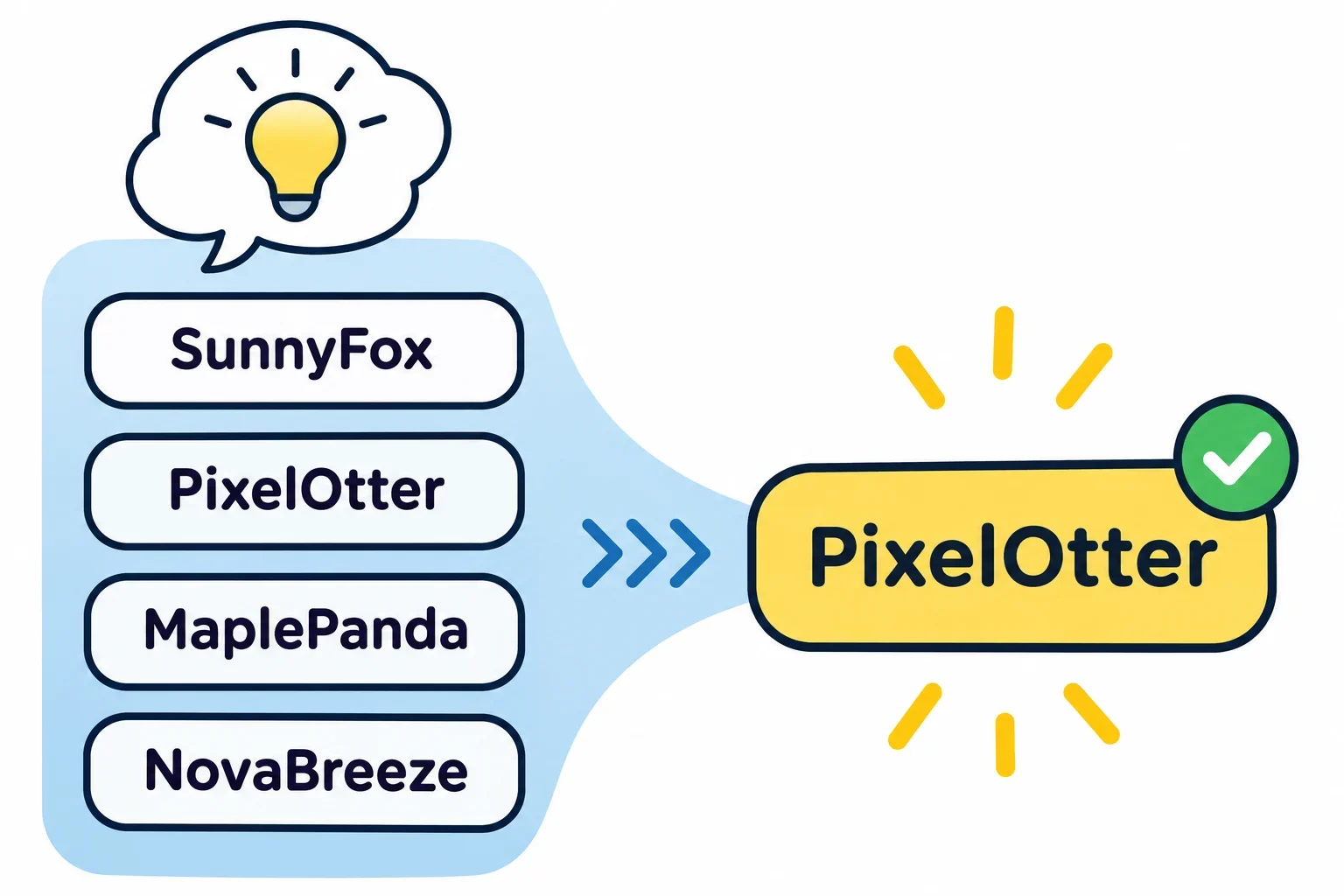
The easiest generated username to remember is one that gives you a clear mental picture and is simple for you to say, spell and type. Start with a word that means something to you without revealing personal details, then compare a few combinations before checking your favorite on each platform where you plan to use it.
A good choice does not have to be the shortest or cleverest option. It should suit the way you will use it: a public handle you expect to share aloud may need to be immediately recognizable, while separate usernames may better suit accounts you prefer to keep distinct. Use the steps below to find a name that works for your own memory and privacy preferences.
Start with a word you can remember
Choose a starting word that brings a picture or idea to mind. An object, color, landscape or imagined creature can give you something concrete to recall. For example, “lantern” may be easier to remember if you can picture its light; “meadow” might work if it suggests an open, green scene. These are prompts for your imagination, not rules about which words everyone remembers best.
You can also choose a word with a private association: perhaps it reminds you of a story you made up or an image you enjoy. The association can be meaningful to you without being publicly known. Before using the word, consider what the username itself would disclose. Avoid readily accessible personal details, such as your full name or other information someone could easily connect to you.
Give yourself a few starting points
Write down three or four unrelated words. Say each one aloud, then look away and try to recall the list. Keep the word that returns most naturally, even if another seems more unusual on the page. If none sticks, try a different category: a familiar object instead of a color, for example.
Think about the impression you want to create, too. A playful image may suit a casual account, while a more neutral combination might feel better for a handle you will share in different settings. You do not need to explain the personal meaning behind your choice; it only needs to help you remember it.
Generate a shortlist
Use your starting word as a guide while exploring generated suggestions. If the generator lets you enter a word, try it as an input. If it offers choices for words or separators, experiment with the available options; if it does not, look through the suggestions for combinations that give you a similarly clear image. The aim is to collect possibilities, so there is no need to choose the first result that looks appealing.
Keep a small shortlist of three to five candidates. This gives you enough variety to compare without having to remember a long collection of near-identical names. Include at least one simple option and, if you like, one that feels more playful. You can also note a possible backup at this stage.
For illustration, imagine a shortlist built around the word “lantern”:
MeadowLantern: two familiar words that form a scene.LanternMoth: an image with a different order and rhythm.Lantern_Moth: the same words with a separator to remember.MothLantern7: a variation with an added number.
These examples show what to compare; they are not claims that the names are available. Your own suggestions may look quite different. Copy candidates accurately as you review them, including any capital letters, separators or numbers, so you can test the actual strings you are considering.
If every suggestion feels awkward, return to your starting word or try another combination. A shortlist is useful when its members are genuinely distinct enough for you to make a choice, not when it preserves every result you have seen.
Compare length, sound and spelling
Now put the candidates through a few practical tests. A short, recognizable name that is easy to spell is a useful starting point, but your own ability to recall and share it matters more than a character count alone. A slightly longer pair of familiar words may be easier to remember than a compact string of unfamiliar letters.
| Check | What to do | What to notice |
|---|---|---|
| Length | Count every letter, number and separator. | Can you type the whole name comfortably? |
| Sound | Say it aloud as though telling someone your handle. | Does it have a natural rhythm, or do you stumble? |
| Spelling | Look away, then write or type it from memory. | Which letters, numbers or separators do you miss? |
| Sharing | Ask someone to write it after hearing it once. | Do they need you to repeat or spell parts of it? |
You can do the sharing test yourself if nobody is available: say the name aloud, wait a little, then write it down. Comparing the result with the original may reveal a detail you keep dropping. A second person can add a useful perspective because they will not already know the intended spelling.
Pay attention to extras
Numbers and separators can make an otherwise clear name harder to communicate. With Lantern_Moth, for example, you must remember both the underscore and its position. With MothLantern7, you must remember the final digit. Unusual letter substitutions can create a similar problem if the spoken name does not tell a listener how to spell it.
Extras are not automatically bad choices. Keep one if it has a reason you can remember and you are comfortable explaining it. Otherwise, favor the candidate you can reproduce accurately after looking away.
Test the word combination
A memorable combination often gives you a connection between its parts. Picture MeadowLantern, for instance, as a lantern sitting in a meadow. The image does not have to be realistic or meaningful to anyone else; it simply gives you a way to reconstruct the words and their order. Try describing each candidate in one sentence. If you cannot form an image or idea from it, another option may be easier to keep in mind.
Next, inspect the joined text carefully. Read it as one continuous string as well as two separate words. Can the boundary between the words be understood? Does a different reading suggest something you did not intend? A combination that seems clear when you already know the two words may look different to someone encountering it for the first time.
Try a fresh reading
Set your list aside for a while, then return to it without looking at your notes about what each name means. Write down the words you see and the impression each combination gives you. If possible, ask someone else for their first reading without explaining the intended image. You are looking for confusion or an unintended association, not trying to make everyone interpret the name identically.
If the wording is unclear, swap the order, choose a different second word or consider a separator if the relevant platform accepts it. Then repeat the sound and spelling checks: a change that makes the word boundary clearer may also add something you need to remember when sharing the name.
Check the final choice
Take your preferred candidate to each platform where you intend to use it and check it in that platform’s own username field. Enter the exact spelling you want, including any numbers or separators, and follow the feedback shown there. A name that works in one field may need a different form elsewhere, so make the check separately for every intended account.
Keep a memorable backup ready in case your first choice is unavailable or not accepted. Before adopting a modified version, give it the same quick test as your original: say it, type it from memory and check the combined meaning. Adding an arbitrary number may solve one problem while creating another if you cannot remember which number you chose. A different word combination may be easier to live with.
Decide how widely to reuse it
A consistent public handle can make it simpler for you to tell people where to find you. It may also make your accounts easier to connect with one another. If you would rather keep parts of your online activity separate, consider using different usernames for those accounts. Choose according to your purpose and the degree of separation you want.
Before you settle on the name, ask yourself:
- Can I recall and type it accurately after looking away?
- Could someone spell it after hearing it once?
- Does it evoke an idea without revealing personal details?
- Have I checked the exact version on each intended platform?
- Can I remember the backup if I need it?
Once a candidate passes those checks and feels right for its intended use, you have a practical choice. Keep a private note of the exact spelling if that helps, especially while the new username is still unfamiliar.