Contents
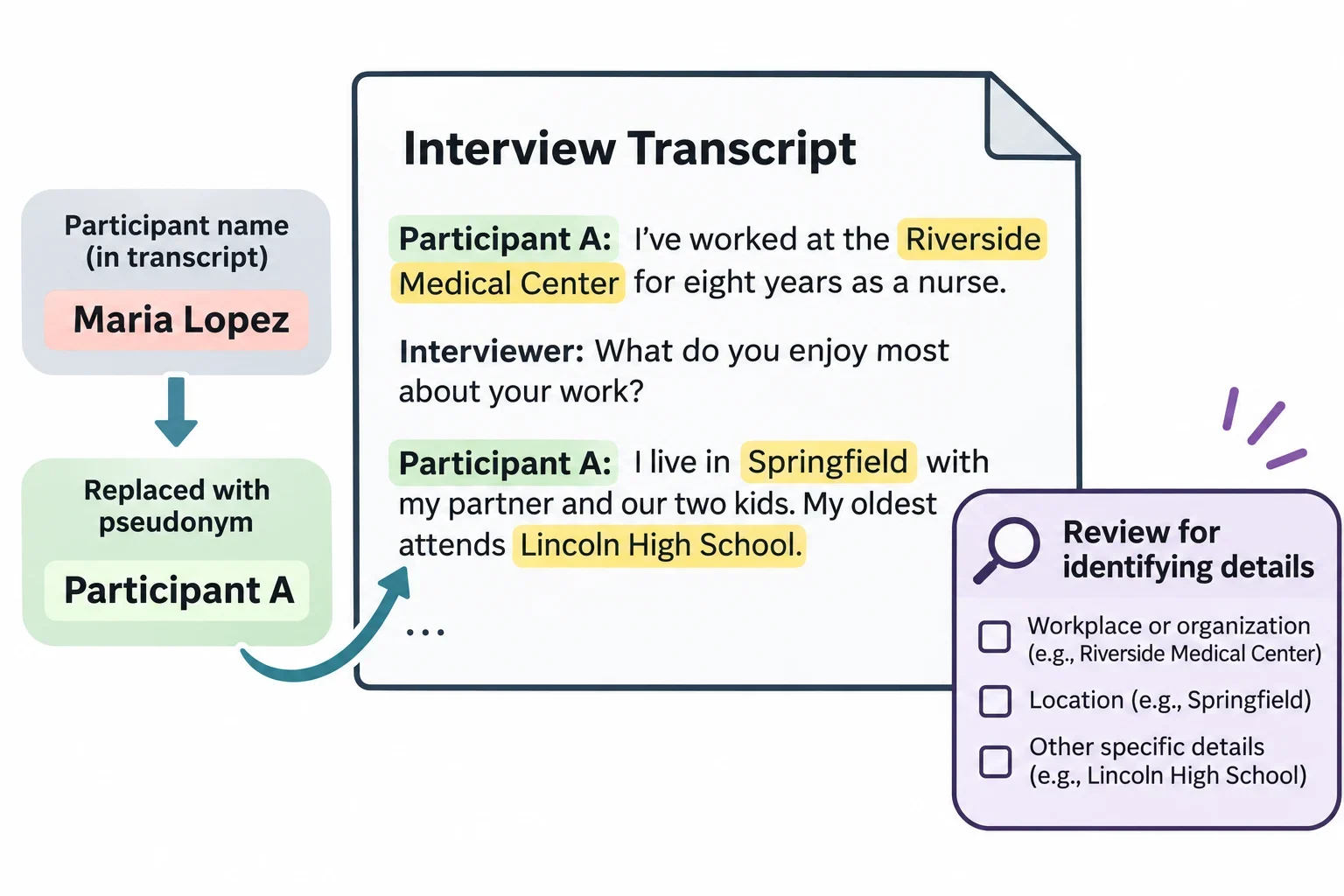
To create pseudonyms for interview transcripts, choose a distinct fictitious name for each participant, record the link in a protected mapping, and use the same name consistently across your materials. A person name generator can help you build a shortlist, but the final choice and the privacy review are yours.
Replacing names is only the beginning. A job role, place, or distinctive event can still point to someone, especially when details appear together. This guide walks through choosing names, applying them carefully, and deciding what else to generalize or remove before a transcript is shared.
Choose names that fit the project
Start with a list of participants who need pseudonyms and decide how you will distinguish them in your working materials. Then use a person name generator to gather candidate names. You do not need to enter participants’ real names or interview details to make a shortlist; work with the suggestions the generator provides and select names separately.
Choose names that are easy for your intended readers to tell apart. For example, if two participants appear in the same discussion, “Mara” and “Jonah” may be easier to follow than two names with similar spelling. Check your shortlist against the other pseudonyms already in use, and avoid a candidate that could be confused with a real person mentioned in the material.
Consider what a name suggests
A pseudonym can create impressions about a person. Before settling on one, ask whether it introduces an association that matters to the project or could mislead a reader. Avoid guessing a participant’s identity or background from a name. If a particular characteristic is relevant to your analysis, consider how to represent it accurately without relying on a reader’s assumptions.
Where appropriate, invite participants to express a preference about their pseudonym, within the project’s requirements. If someone requests a change, check whether the new choice is distinct from names already assigned and update the mapping and relevant materials together.
Keep a few alternatives on your shortlist until you have checked the full set. The aim is a name that helps readers follow the account without drawing unnecessary conclusions about the person behind it.
Record and protect the mapping
Create a mapping that links each participant to the one pseudonym chosen for them. A simple working record might contain a participant identifier, the real name needed to make the link, and the assigned pseudonym. Include only information you need for the task; the transcript itself does not need to contain the identity mapping.
For example, a mapping could show that participant P01 is assigned “Mara” and P02 is assigned “Jonah.” The working transcript can then use those pseudonyms without displaying the real names. If you use identifiers in other records, check that the link between the identifier and the pseudonym is consistent as well.
Decide who needs the link
Store the mapping separately from transcripts and limit access to people who need it for an authorized project task. Before choosing a storage location, check your project’s requirements and the protections available to you. Consider who can open the mapping, who can change it, how access will be granted or removed, and how it will be kept secure when collaborators need it.
Agree on one responsible process for updating the record so that two people do not assign different names to the same participant. If a pseudonym changes, record the decision and check each affected item before using the new name elsewhere. Avoid putting the mapping in a shared transcript or an accompanying note simply for convenience.
Also check the project’s rules for retaining or disposing of the mapping. The right arrangements depend on what you have agreed to do with the interviews and what your project requires.
Apply pseudonyms throughout the materials
Work from the protected mapping and replace each participant’s name in the transcript with the assigned pseudonym. Look beyond the first mention: names may appear in speaker labels, introductions, questions, quoted speech, notes, and summaries. Use the same fictitious name in related materials so readers can follow the same person across them.
Make a list of variants to check for each participant. Depending on the interview, those might include a first name, a full name, a nickname, initials, a former name, or a spelling variation. Review references to other people too; a family member or colleague mentioned in an answer may need a separate treatment under your project’s approach.
Check replacements in context
Search can speed up the work, but automated changes can miss variants or alter words unintentionally. Review each result in context, especially when a name is also an ordinary word or forms part of another name. Read the surrounding sentence after a replacement to make sure it still makes sense and refers to the intended person.
For a practical pass, search one variant at a time, make the appropriate changes, and then search again. Follow that with a read-through of the transcript and a check of related materials. If a speaker refers to “my sister” rather than using her name, decide whether that description is suitable in context; a name search alone will not make that decision for you.
Keep track of which materials you have reviewed and which remain. If you revise the transcript later, repeat the relevant checks on the new or changed text before sharing it.
Review the surrounding details
After replacing names, read the transcript for details that might reveal a participant or another person indirectly. A distinctive life event, job role, or geographic reference can allow someone to infer an identity even when the name is gone. Consider people, organizations, places, and events mentioned in questions as well as answers.
Do not assess each detail only in isolation. A broad location may seem harmless on its own, while the same location paired with an unusual role and a distinctive event could narrow the possibilities. Ask who might read the material, what they may already know, and whether the combination could point to someone. Apply the same review to third parties who did not take part in the interview.
Generalize when it preserves the point
You can reduce specificity while retaining meaning that matters to the analysis. Suppose an invented transcript names a small organization only to explain that a participant worked locally. A phrase such as “[a local organization]” may preserve that point without repeating its name. If the exact organization is essential to the argument, consider how the material can be used under the project’s terms rather than assuming the name must remain.
A complete redaction may be more suitable when even a broad description would reveal too much, or when the specific passage is not needed. For example, “[detail removed]” can show that material was taken out without supplying a replacement description. Check that the surrounding sentence remains understandable and does not accidentally disclose the same detail elsewhere.
Use the least specific wording that still serves the intended purpose, and review the passage again in combination with the rest of the transcript. A broad description can protect context, but it is not automatically safe in every setting.
Document changes and review disclosure risk
Keep a log of anonymization changes and the decisions behind them. It can record what kind of detail was changed, the general approach used, and where the change appears. For instance, a note might say that an organization name was generalized because the interview could be understood without the specific name. Protect the log appropriately if it contains original details or could otherwise reconnect a transcript to someone.
Make substitutions visible to readers when that suits the material and project requirements. Brackets are one way to show an editorial change, as in “[a local organization]” or “[detail removed].” Apply your chosen convention consistently and explain it in an editorial note if readers need help interpreting the transcript. The note itself should not reveal the information you are trying to protect.
Before sharing
Review the intended version as a reader would encounter it, including speaker labels, surrounding passages, and any related summaries. Ask these questions:
- Are pseudonyms consistent, and have name variants and replacement errors been checked?
- Could a combination of roles, places, events, or relationships identify a participant or a third party?
- Does each generalization preserve the meaning needed for the intended use?
- What do the participant’s consent terms and the project’s requirements permit you to share, with whom, and in what form?
Resolve uncertainties through the appropriate project process before distribution. A pseudonym alone does not make interview information anonymous or confidential, and a change that works for one intended audience may need another review for a different use. If you revise the material or plan a new way to share it, revisit the decisions and update the log.